
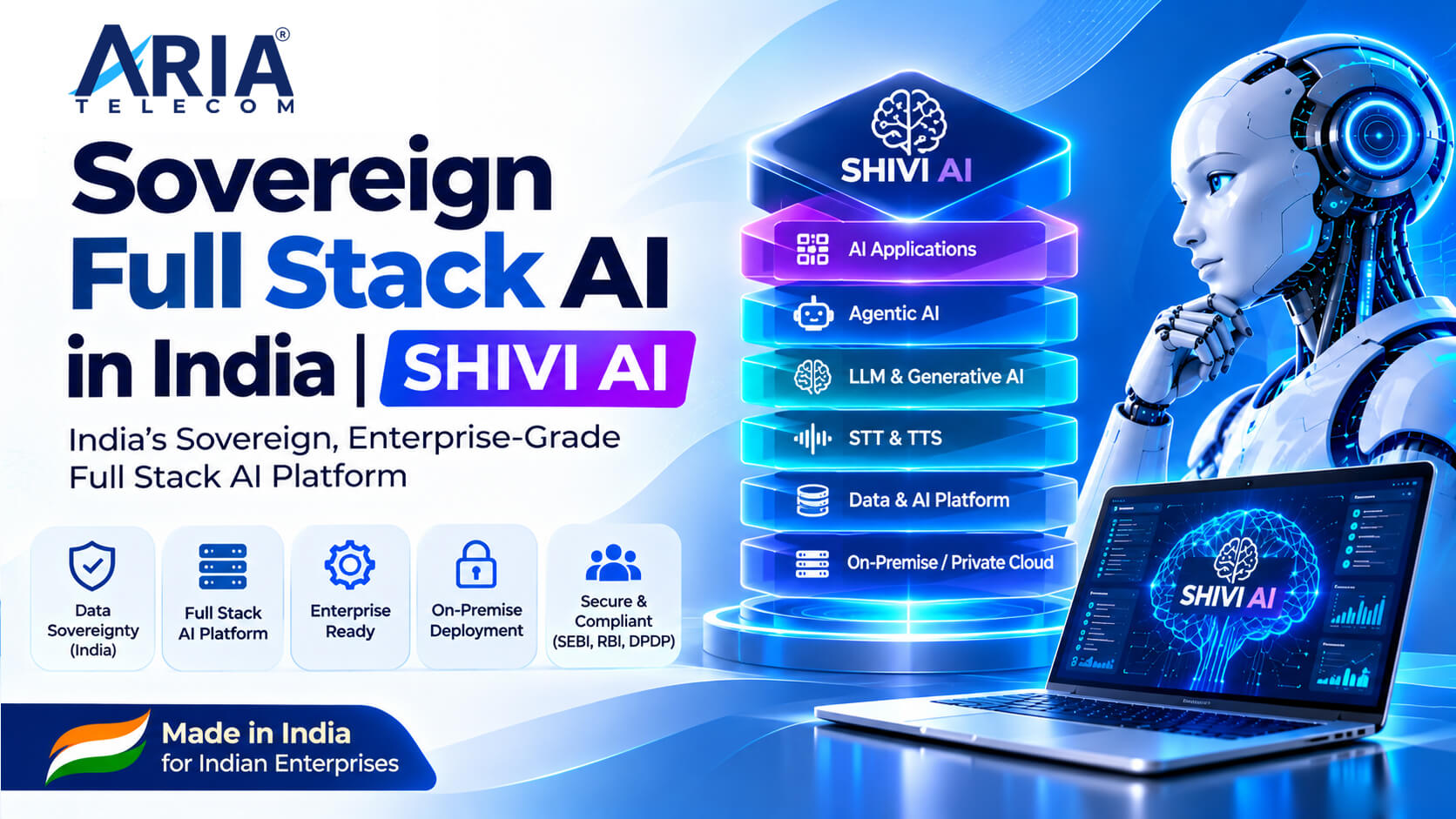
Sovereign Full Stack AI in India: A New Approach to
Secure and Intelligent Business Operations
Artificial intelligence is transforming how businesses manage customer interactions, automate workflows, analyse information, and make better decisions. However, as organisations increasingly adopt AI-powered technologies, concerns about data privacy, security, regulatory compliance, and control over business information are becoming more important. Businesses need advanced AI capabilities while maintaining control over their data, infrastructure, and technology.
Sovereign Full Stack AI in India represents a new approach to artificial intelligence that combines AI infrastructure, models, speech technologies, intelligent automation, and data governance within a controlled technology ecosystem. It enables businesses to adopt AI solutions while aligning technology deployment with their security requirements, operational policies, and business objectives.
SHIVI AI supports this transformation through AI-powered voice assistants, conversational AI, chatbots, speech technologies, and on-premise AI solutions. These technologies help organisations build secure, intelligent, and efficient business operations.
What Is Sovereign Full Stack AI?
Sovereign Full Stack AI refers to a complete artificial intelligence ecosystem that provides greater control over AI infrastructure, models, data, applications, deployment, and governance. Instead of depending entirely on multiple external platforms, businesses can use an integrated AI environment designed around their operational and security requirements.
A full-stack AI ecosystem can include:
- AI Infrastructure: Computing resources and deployment environments for running AI workloads.
- Large Language Models: AI models that understand, process, and generate human language.
- Speech Technologies: Speech-to-text and text-to-speech capabilities for voice-based applications.
- Conversational AI: Intelligent systems that communicate with customers through natural conversations.
- AI Applications: Voice assistants, chatbots, automated communication, and business automation tools.
- Data Governance: Policies and controls for managing sensitive information and AI operations.
- Security and Privacy: Authentication, access management, encryption, and monitoring.
These components work together to create an integrated AI ecosystem that supports different business requirements.
Why Do Indian Businesses Need Sovereign Full Stack AI?
Indian businesses across banking, healthcare, telecommunications, government services, utilities, and customer support handle significant amounts of confidential information.
Using artificial intelligence without proper data governance can introduce challenges involving information sharing, third-party dependencies, security, and accountability.
A sovereign approach helps businesses address these challenges while adopting advanced AI technologies.
1. Better Control Over Business Data
Businesses need visibility into how AI systems process
customer conversations, employee information, business documents, and
operational records.
A controlled AI environment helps organisations define where information is stored, who can access it, how it is processed, and how long it is retained.
2. Improved Security and Governance
AI systems should operate within clearly defined security
policies. Controlled deployments can support authentication, role-based
permissions, audit logging, and integration with existing security
infrastructure.
These capabilities help businesses maintain better oversight of their AI operations.
3. Complete AI Technology Ecosystem
A full-stack AI approach brings multiple technologies
together instead of requiring separate solutions for every business
requirement.
Businesses can integrate language models, speech recognition, voice generation, conversational AI, and intelligent applications into a connected ecosystem.
4. Flexible Deployment Options
Different organisations have different infrastructure
requirements. Some may prefer private cloud environments, while others may
require AI systems deployed within their own data centres.
Flexible deployment allows businesses to select an architecture that meets their technical, operational, and security requirements.
5. Reduced Dependence on External AI Services
Depending entirely on external AI platforms can create
limitations concerning customisation, pricing, infrastructure control, and data
handling.
A sovereign approach can provide greater control over important AI workloads, depending on the selected architecture and implementation.
How SHIVI AI Supports Sovereign Full Stack AI Adoption
SHIVI AI focuses on communication technology, artificial
intelligence, and intelligent automation. Its AI capabilities help
organisations improve customer engagement, automate communication, and develop
integrated business applications.
The technology ecosystem includes several important AI components.
AI Voice Assistants for Business Communication
AI voice assistants help businesses automate customer
interactions through natural conversations. They can answer customer questions,
provide service information, handle routine enquiries, and support
communication workflows.
These voice assistants can be integrated with existing business applications to improve customer service and reduce repetitive manual work.
For organisations with strict data requirements, voice AI can be evaluated for deployment within an approved infrastructure environment.
Conversational AI and Intelligent Chatbots
Conversational AI enables businesses to communicate with
customers and employees through natural-language interactions.
AI chatbots can provide information, answer frequently asked questions, guide users through processes, and connect people with relevant departments.
With suitable integrations and access controls, conversational AI can improve service availability while maintaining oversight of information access.
On-Premise AI Infrastructure
On-premise AI allows organisations to host supported AI
workloads within infrastructure they manage or control.
This approach can be useful for businesses requiring greater control over network access, data movement, system configuration, and internal integrations.
SHIVI AI's on-premise AI capabilities can support businesses evaluating controlled AI deployments. The actual level of data sovereignty depends on the selected models, infrastructure, deployment architecture, and operational policies.
Speech-to-Text and Text-to-Speech Technologies
Speech-to-text technology converts spoken language into
written information, while text-to-speech technology generates natural-sounding
speech from text.
These capabilities support:
- Automated customer service.
- Voice-enabled applications.
- Call analysis and conversation intelligence.
- Multilingual customer communication.
- Automated calling systems.
- AI-powered virtual assistants.
When integrated into a properly governed AI environment, speech technologies can help businesses automate voice workflows while applying appropriate controls to recordings, transcripts, and related information.
Large Language Models and AI Applications
Large Language Models enable AI applications to understand
user queries, process information, generate responses, and support intelligent
workflows.
Businesses can use these capabilities for customer support, knowledge management, automated communication, and information processing.
Combining language models with speech technologies and conversational applications creates a connected AI ecosystem.
Which Industries Can Benefit from Sovereign Full Stack
AI?
Sovereign Full Stack AI can support different industries,
particularly those with demanding data governance, communication, and
operational requirements.
Banking and Financial Services: AI assistants can answer customer queries, provide service information, and automate routine interactions. Financial institutions can implement appropriate controls for sensitive financial information and customer authentication.
Healthcare: Voice assistants and chatbots can support appointment scheduling, patient enquiries, and administrative workflows. Healthcare applications require careful handling of personal and medical information.
Government and Public Utilities: AI-powered helplines can help manage citizen enquiries, service requests, complaints, and information access.
Telecommunications: AI can automate customer support, service enquiries, and routine communication workflows while integrating with existing communication infrastructure.
Customer Support and Contact Centres: Contact centres can use conversational AI, voice automation, and speech processing to improve response times, reduce repetitive work, and support human agents.
Education: AI-powered assistants and chatbots can help educational institutions manage student enquiries, admission information, course details, and administrative communication.
How to Choose the Right Sovereign Full Stack AI Solution
Before adopting a full-stack AI solution, businesses should
evaluate their technical infrastructure, security requirements, and operational
objectives.
Consider the following factors:
- Deployment Options: Determine whether on-premise, private cloud, or another controlled environment meets your requirements.
- Data Handling: Review data storage, retention, processing, backup, and deletion policies.
- Access Management: Check authentication, user permissions, administrative access, and audit trails.
- AI Model Control: Understand how models can be configured, updated, monitored, and managed.
- Technology Integration: Ensure compatibility with existing CRM, contact centre, telephony, and business applications.
- Performance: Evaluate accuracy, latency, scalability, multilingual capabilities, and reliability.
- Security: Review encryption, network controls, monitoring, and third-party dependencies.
- Technical Support: Evaluate implementation assistance, maintenance, documentation, and ongoing support.
Businesses should also understand whether model inference, logging, telemetry, backups, and support operations remain within their required data boundaries. Local hosting alone does not automatically guarantee complete data sovereignty.
Is Sovereign Full Stack AI the Same as On-Premise AI?
No. Sovereign Full Stack AI and on-premise AI are related but different concepts.
On-premise AI refers to a deployment model in which AI workloads operate on infrastructure located within an organisation's premises or controlled facilities.
Sovereign Full Stack AI is a broader approach that combines AI infrastructure, models, applications, data governance, security, and deployment control.
An on-premise deployment can contribute to a sovereign AI strategy, but complete sovereignty depends on how the entire technology ecosystem is designed and managed.
Similarly, a properly governed private cloud environment may meet certain data sovereignty requirements.
The right approach depends on business needs, infrastructure, security policies, and applicable regulatory obligations.
The Future of Sovereign Full Stack AI in India
As Indian organisations expand their use of artificial intelligence, the demand for secure, scalable, and integrated AI technologies will continue to grow.
Businesses increasingly require AI systems that can understand natural language, communicate with customers, automate workflows, and process information while maintaining appropriate control over their technology infrastructure.
SHIVI AI supports this transformation through AI-powered voice assistants, conversational AI, intelligent chatbots, Large Language Models, speech technologies, and controlled deployment options.
By bringing these capabilities together, businesses can explore a more integrated approach to artificial intelligence that supports automation, communication, security, and operational efficiency.
Sovereign Full Stack AI represents an opportunity to build a connected AI ecosystem with greater control over technology, infrastructure, and business data.
Looking to adopt advanced AI technologies? Explore SHIVI AI's full-stack AI capabilities to discover solutions for intelligent communication, business automation, and secure AI deployment.
No comments yet. Be the first to share your thoughts!